

An Interview with Dan Coxon
By Paul StJohn Mackintosh
Dan Coxon has won two British Fantasy Awards, for Writing the Uncanny and Writing the Future (both co-edited with Richard V. Hirst), and has been shortlisted for the awards a total of seven times. He has also won a Saboteur Award, and was a finalist for the Shirley Jackson Awards. His short stories have appeared in various anthologies and magazines, including Shakespeare Unleashed, Beyond the Veil, Fiends in the Furrows III and Great British Horror 7: Major Arcana. His most recent anthology is Heartwood: A Mythago Wood Anthology (PS Publishing); his second short story collection, Come Sing for the Harrowing, will be reprinted by CLASH Books in Spring 2026. He will be appearing at the Edge-Lit 11 genre fiction festival in Bedford, England, on September 20, 2025.
 PSM: Come Sing for the Harrowing is only your second collection in five years. What’s the nature of your creative process and the sources of your inspiration?
Dan: Without going into too much detail, there were matters beyond my control (mainly the original publisher closing its doors) that delayed the release of Come Sing for the Harrowing. It was never intended to be five years! I basically lost more than a year while finding it a new home. If all goes well, I should have another collection out in 2026 (less horror, more magic realism), so it’ll be a bumper year!
I do tend to write slower than some people, though, largely because I also edit both fiction and non-fiction anthologies. I’ve had at least one book published per year during that period, sometimes two (and three anthologies coming next year, in addition to the two collections), so often my time is taken up with working on those projects. I just don’t always have enough hours in the day to write as well. I figure as long as I’m working on a book project of some sort – whether my own writing or other people’s – then I’m actively working.
That said, I’d also rather publish four really good stories in a year than twenty bad ones. I work quite hard on editing and refining my own writing once the first draft is finished, so it’s often a slow process.
PSM: You’ve been very active as an editor and anthologist, with several highly regarded anthologies to your name. How does this interrelate with your own work as a writer?
Dan: I was once on a panel where a well-known elder statesman of the horror scene suggested that you couldn’t be both an anthology editor and a writer – but I strongly disagree. You only have to look at someone like Mark Morris to see that’s clearly untrue. For me personally, I think both aspects strengthen the other: I’m a better writer because I’ve learned to edit well, and a better editor because I’m used to being on the other side of the edits, which allows me to understand a writer’s intentions a little better.
If there’s one lesson that has taught me, then it’s to listen to my own inner editor more closely. When I write, I’ll often have a gut feeling that something isn’t working, but there’s a tendency as a writer to convince yourself that you can get away with it – that readers won’t notice, or it won’t lessen their enjoyment. Both those responses are basically self-delusion. Nobody is going to love your work as much as you do – so if you can see the flaw in it, it’ll be glaringly obvious to other readers. Listen to your inner editor; do the work.
I’ve also had a lot of success placing stories with high-profile anthologies in recent years, and I do put that down to my own experiences as an anthology editor. Especially with themed anthologies, there’s often a sweet spot to be found between hitting the theme head-on and taking an approach that no one else will think of. If you can get that right – and write the story well – then an editor’s immediately going to be interested.
PSM: Do you have particular sub-genres or niches, and if so, why?
Dan: In recent years I’ve come to the conclusion that I have a short attention span – which probably seems odd for someone who spends all day staring at a screen and polishing manuscripts on a granular level! I do find that it’s important to follow my own interests in my writing, though – and these change fairly frequently. Come Sing for the Harrowing is explicitly an attempt to take folk-horror tropes and twist them into new shapes, for example, but that’s probably the last time I’ll approach folk-horror, at least for a while. I’ve been working on a haunted house-themed anthology recently (Unquiet Guests, out with Dead Ink Books this Halloween), and probably for that reason I’m intrigued by classic ghost stories at the moment, and poltergeists in particular. I’ve also been looking at the intersection between science fiction and horror, which I find inherently strange. I might head in that direction at some point.
(Actually, now I think of it, my story in And One Day We Will Die: Strange Stories Inspired by the Music of Neutral Milk Hotel, ‘Terminus’, dabbled in that a little.)
PSM: What’s your evaluation of the current state of British weird fiction? Any significant themes?
Dan: I’m always reluctant to watch the current scene too closely. Publishing moves so slowly that you can’t really chase trends anyway – it takes a good couple of years for some books to be published, and what’s hot now might be old news by then. Better to follow your personal interests and obsessions, and create your own trend.
Having said that, I do think horror is still hot, but the genre publishing scene tends to be leaning more and more towards quite straightforward, traditional horror. That’s not to say that weird fiction is disappearing, though – rather, it is often being published as ‘literary’ or mainstream fiction, when in the past it might have been considered an oddity or an outlier. Which is great news for the reader of weird fiction – you can actually walk into a high street bookshop and find some pretty weird stories these days!
I do a lot of work with Dead Ink (they’re publishing Unquiet Guests, as well as the books on writing that I’ve co-edited with Richard V. Hirst: Writing the Uncanny, Writing the Future, Writing the Murder and Writing the Magic) and they’re a fine example of this new trend. They’ve published some wonderful weird fiction, such as Matt Hill’s Lamb or Gerardo Sámano Córdova’s Monstrilio, but I wouldn’t say they were a niche ‘weird fiction’ publisher. As well as making it easier to get your hands on strange, challenging works, it’s also introducing a whole new readership to this kind of fiction – which can only be a good thing!
- About the Author
- Latest Posts
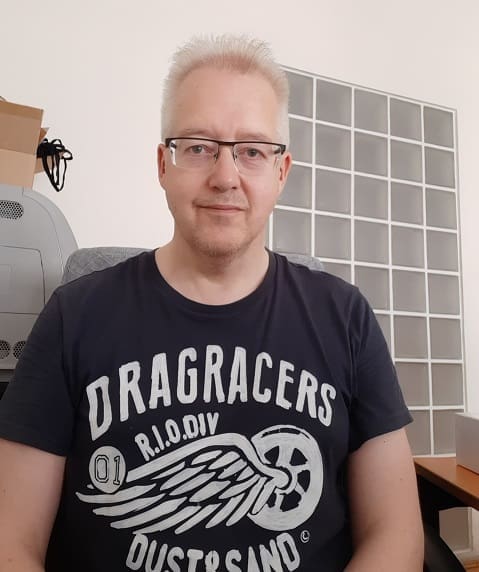
Paul StJohn Mackintosh is a Scottish author, poet, journalist, historian, games writer, and media professional. Born in 1961, he was educated at Trinity College, Cambridge, has lived and worked in Asia and Central Europe, and currently lives in France.
Paul’s first collection of short stories, Black Propaganda, appeared from H. Harksen Productions in 2016. His second story collection, The Echo of The Sea & other Strange War Stories, was published by Egaeus Press in 2017. His short novel The Three Books was published by Black Shuck Books in 2018. His short story “The People of the Island,” in Eldritch Horrors: Dark Tales, from H. Harksen Productions, received an Honorable Mention from Ellen Datlow in her Best Horror of the Year Volume Two list for 2009 and his story “The First Circus of the New Year” received the same in 2016. His historical novel Begin the Beguine and his semi-autobiographical novel Death of a Doppelgänger were both published in 2023. He has written several books of French wartime history. His latest horror work is his apocalyptic novel Theogasm (2024).
Paul’s acclaimed first poetry collection, The Golden Age, was published by Bellew Publishing in 1997, and reissued on Kindle in 2013. His second poetry collection, The Musical Box of Wonders, was published by H. Harksen Productions in 2011. His sonnet cycle The Great Arcana: Sonnets for the 22 Trumps of the Tarot, and his ballad cycle Black Ballads, based on traditional Scottish myths and legends, were both published in 2022.
Paul’s Lovecraftian and dark fiction, and criticism, has appeared in numerous formats and journals worldwide, including Occult Detective Magazine, Weirdbook, the Los Angeles Review of Books, Strange Horizons, the Financial Times, the UK Independent, the Times Literary Supplement, Arts of Asia, Strange Horizons, A Broad Scot, and elsewhere. His co-translations from the Japanese, done with Maki Sugiyama, include The Poems of Nakahara Chuya (1993) and Nip the Buds, Shoot the Kids (1995) by the 1994 Nobel Prize-winner Kenzaburo Oe, which won a Japan Festival Award. He also co-translated Superstrings (2007) by Dinu Flamand from Romanian with Olga Dunca. Paul is a former Executive Committee member of the Translators Association of the Society of Authors of Great Britain. He was rated #1 of “The 12 Publishing Shakers You Should Be Following” by The Independent Publishing Magazine. He is also the official clan poet of Clan Mackintosh.


